Pipeline steps
- Search the primers and short sample indexes (located up-/downstream
of the primer sequences) to group them by sample (de-multiplex); remove
low-quality reads (
do_trim_demux()) - Infer the barcode sequences using a sequential procedure based on DADA2 and/or fixed-threshold
clustering (with DECIPHER);
compare them with already known sequences if present
(
infer_barcode()/do_infer_all_barcodes()) - Auto-assign the taxonomy and compare with the name given by
morphological identification (if present) to validate and check for
contamination (
do_assign_compare_taxonomy()) - Export summary table, which can be further manually curated
(
create_excel_report())
Primer search
It is assumed that sample-specific tags are attached to primers on both sides (dual indexing):
TAG1FPRIMERBARCODESEQUENCERPRIMERTAG2
Combining multiple amplicons is possible. Primers are searched in the order that amplicons appear in the sample sheet. Therefore, if there are nested amplicons, the shorter one should be placed at the end in the sheet.
Clustering
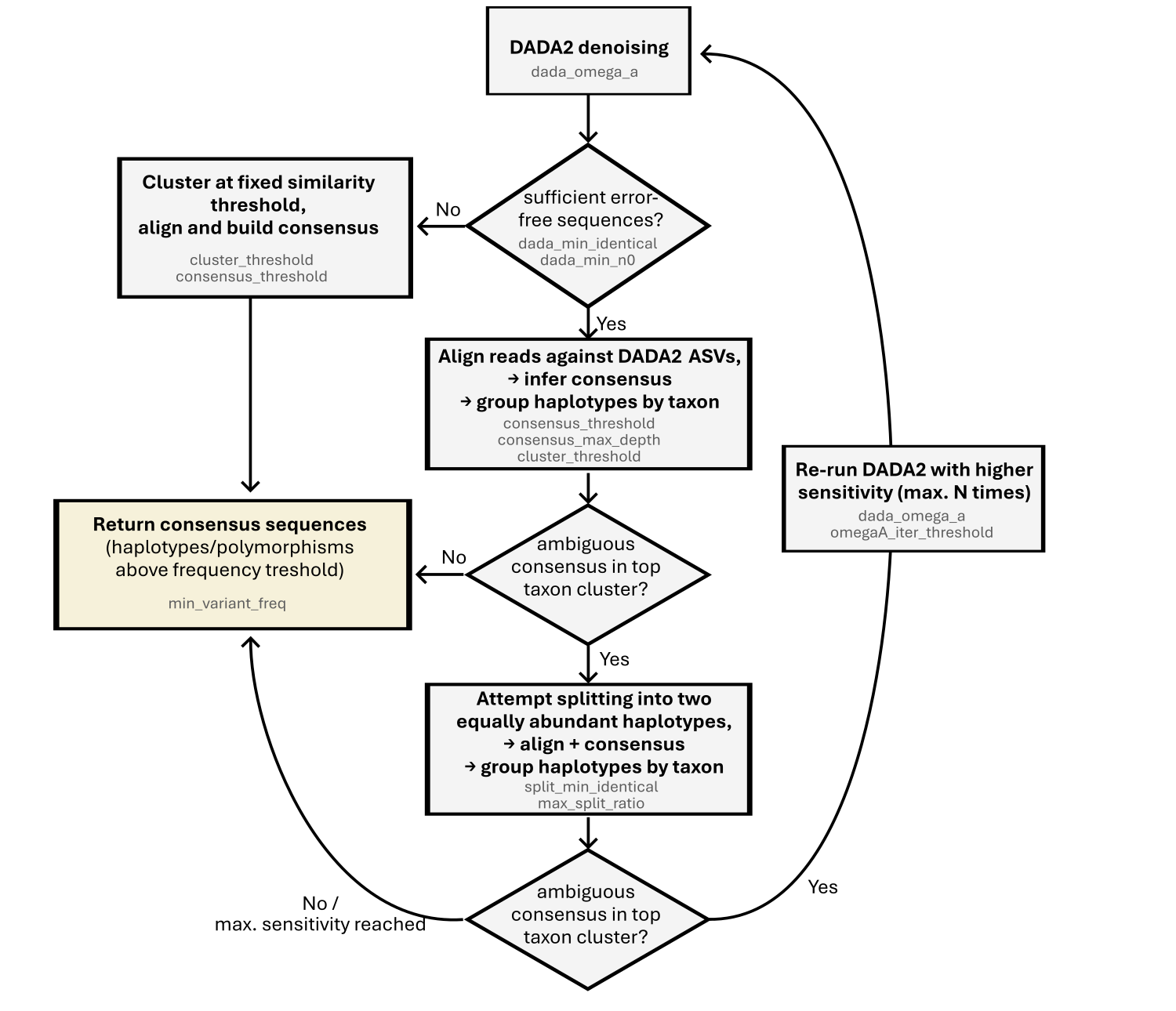
The basic procedure for the clustering is implemented by the
infer_barcode() function. The procedure starts with DADA2
clustering, followed by consensus building. Additional steps may follow
depending on whether the consensus is unambiguous (each alignment column
supported by enough identical bases), or not. The workflow is
illustrated in this flowchart. Relevant configuration options are shown
in grey.
Steps/strategies
DADA2 denoising
DADA2 is a popular program for inferring sequence variants (ASV) in amplicon sequence data. The program requires that there are least a few error-free reads present. If there is not enough duplication, fixed-threshold clustering (see below) is applied instead.
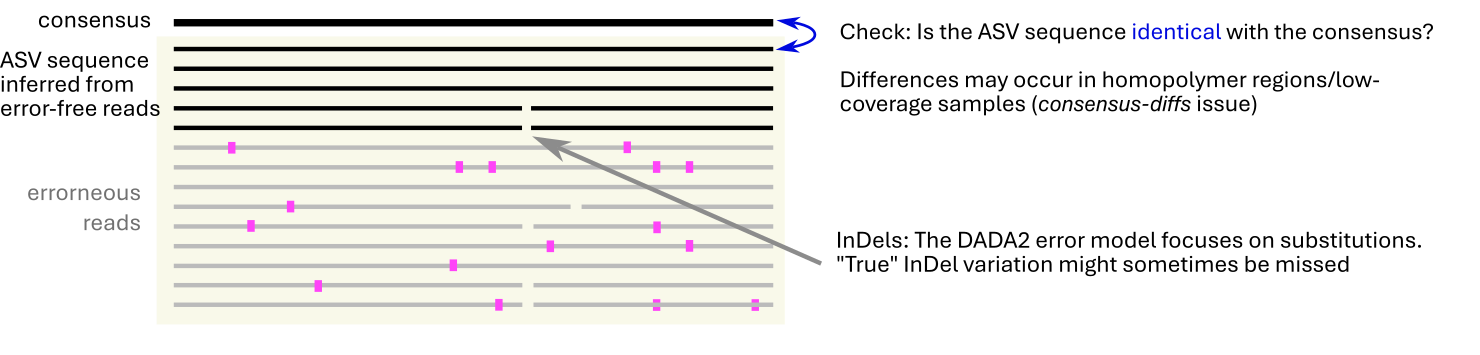
After obtaining the DADA2 ASV(s), the next step is to infer a consensus sequence for the ASV, which should usually be identical with the ASV sequence. Ambiguous bases in the consensus sequence may indicate unresolved sequence variation, which is further addressed by attempting haplotype splitting or by more sensitive denoising (see flowchart).
Haplotype splitting
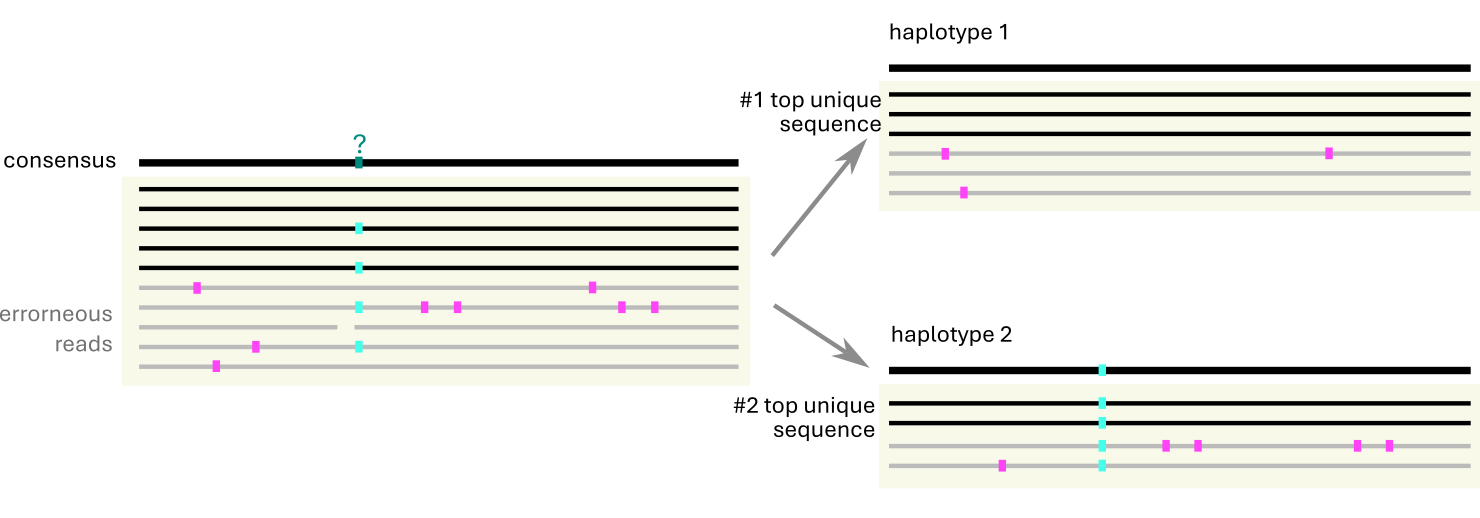
For DADA2 ASVs with an ambiguous
consensus, it is checked if there are two dominant
sequences (supported by a few identical sequences) serving as
references for splitting the sequencing reads into two similarly
abundant sub-clusters with (ideally) unambiguous sequences. The
splitting is done if the total number of ambiguous bases in the two
resulting consensus sequences is smaller than the number of ambiguous
bases in the original consensus of all combined reads (see also
non-public function try_split_haplotypes()).
This simple procedure is often successful and avoids having to re-run DADA2 with higher sensitivity, or it may alo resolve InDel variation that DADA2 did not discover.
Fixed-threshold clustering
Fixed-threshold clustering is applied to low-coverage samples with
insufficient sequence duplication (see dada_min_identical
and dada_min_n0 settings in
infer_barcode().
By default, single-linkage is applied with a 97% identity threshold (with DECIPHER). This can result in an ambiguous consensus sequence, which can still be manually inspected.

How is the consensus sequence determined?
After DADA2 denoising, haplotype splitting and fixed-threshold clustering, the raw (quality-filtered) reads are aligned to the representative sequence (ASV or dominant unique sequence) with Minimap2.
The consensus sequence is then obtained with samtools consensus using a simple frequency-based approach. By default, each base in the consensus sequence needs to be supported by at least 65% of the reads (weighted by quality scores) to be unambiguous. Otherwise, an ambiguous base is shown, which may indicate unresolved sequence variation.
The correctness of the consensus is further ensured by re-mapping the reads against the consensus sequence. If necessary, this step is repeated until samtools consensus returns the same sequence in two successive rounds.
The final reported sequence is always the consensus sequence
(see also vignette("curation")). If the barcode sample has
a sufficient read depth and sequencing quality, it should usually be
unambiguous and correct. For low-depth samples with ambiguities,
alignments might be inspected manually.
Possible issues
Usually, there is a good agreement between sequencing reads, and a simple frequency-based approach seems sufficient. No elaborate neural network-based inference (see e.g. Medaka) is currently applied. In repetitive regions, the current method may have a hard time determining the exact number of repeats.
Homopolymers
The length of long homopolymer repeats is often not
very consistent between different sequencing reads, which can result in
N bases in the consensus. In this case, a simple
frequency-based approach is used to “fix” this situation: the
homopolymer length is taken from the most abundant sequence
(see fix_homopolymers()).
Taxa grouping
Sequence variation within taxa (e.g. haplotypes) is distinguished from between-taxa variation with simple fixed-threshold single-linkage clustering done with DECIPHER (default: 97% threshold). This usually works well at least with the ITS barcode.
The most problematic case would be if there is a closely related contaminant taxon in the DNA extract, which may not be well distinghished from the target taxon.
Taxonomic assignments
Taxonomic names are automatically assigned with the the SINTAX algorithm using a
reference database (see do_assign_compare_taxonomy()).
Second, taxonomic names associated with the specimens are compared to the sequence-based taxonomic assignments. From this, a taxonomic overlap is calculated, which is the proportion of matching ranks in the taxonomic lineages (as far as names are defined at these levels). The lineages are retrieved from the GBIF backbone taxonomy.
Inconsistent taxonomic labels may indicate errors during the
preparation or identification (or possibly the sequence-based
identification), or the presence of contamination. Potential
dominant contaminants are automatically flagged (see
do_assign_compare_taxonomy(), details
section).